A workshop, a guest speaker, a team day, these aren't without value. But they don't change how a team operates in week six of term two, when energy is low, two people are in silent conflict, and the meeting agenda is a list of tasks nobody owns.
Team coaching works differently. It's an investment in how your team thinks, communicates, and leads together, ongoing, embedded in your actual work, and focused on the patterns that are getting in the way or the ones you want to build on. Not a one-off intervention that the week swallows up.
In international schools specifically, every team operates in a distinct context: high staff turnover that resets dynamics every August, cultural complexity that shapes how people communicate and handle conflict, and the reality of professional relationships that are never fully separate from personal ones. Generic team development doesn't reach any of that. This does.
We work on the full picture of how your team operates. Not just the visible friction points, but the underlying patterns that produce them. In international school teams, those patterns are shaped by a context that generic team development never reaches.
How the team communicates across cultural and generational differences, and what's being lost in translation
How new members are brought in and integrated, so August turnover doesn't reset everything you've built
How conflict and tension are handled - directly and early, rather than avoided until they become structural
How meetings are designed and facilitated so that they generate genuine progress rather than compliance
How accountability works in a team where everyone knows each other outside of work
How the team leader's role is understood, by the leader and by the team
Every engagement starts with a scoping conversation to understand your team's context, composition, and what you're actually trying to change. From there, I design a coaching arc specific to your situation.
A typical engagement runs across a quarter or semester - long enough to work through real dynamics, short enough to be manageable alongside everything else your team is carrying.
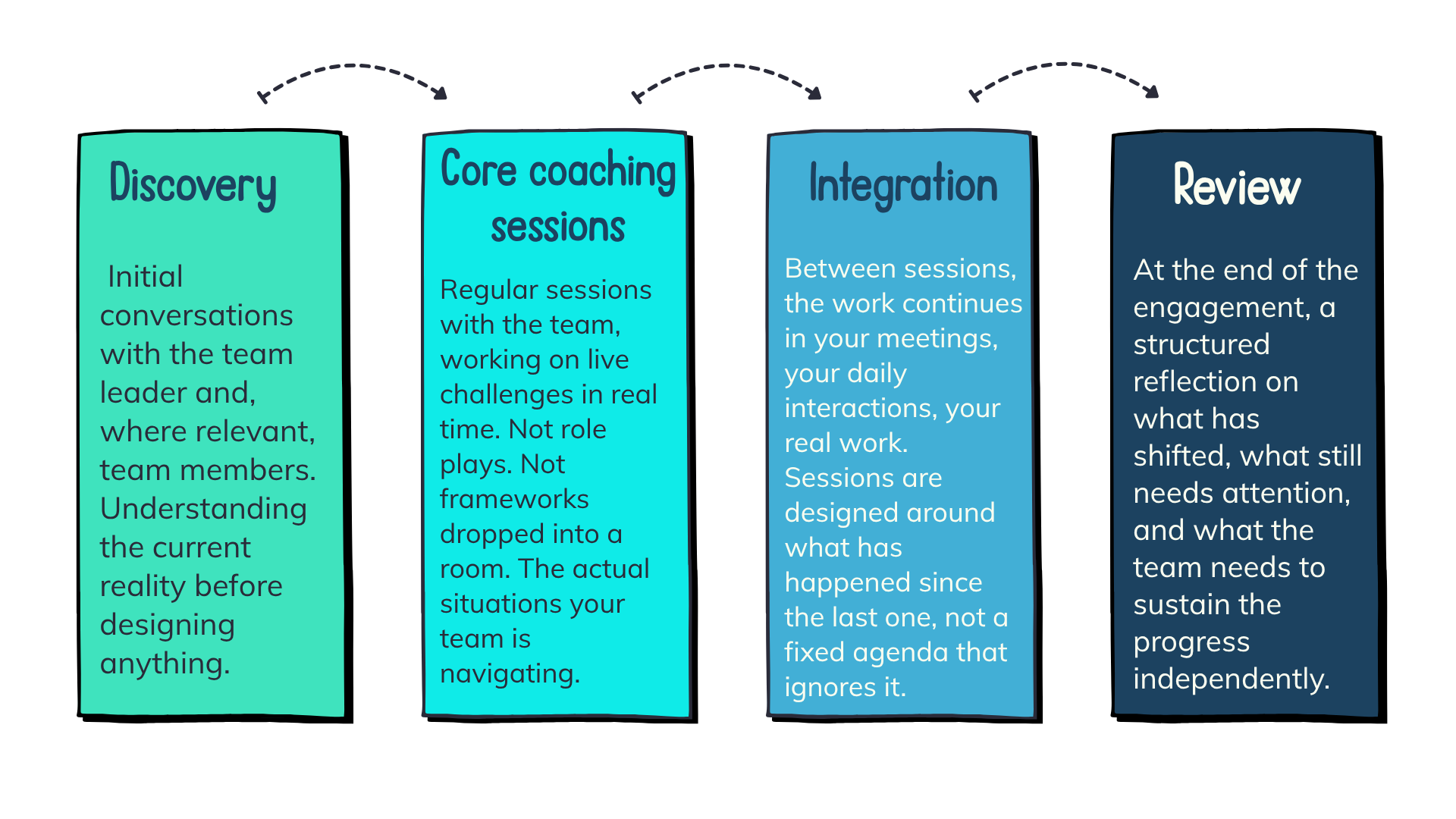
This approach works well at any stage of a team's development, and is particularly well-suited to significant staff turnover, new middle leader appointments, post-accreditation recalibration, or any point where the gap between where your team is and where it could be has become impossible to ignore.
For team coaching to work, the team needs to know it's a genuine development process- not a response to a performance concern, not a remediation exercise. That distinction isn't just semantic. It determines whether people in the room are honest.
It's a structured, confidential coaching process for teams that are ready to look honestly at how they work and willing to do something about it.
Starting from €600, tailored to your team's size, context, and scope of work. Book a discovery call to talk through what your team needs and what an engagement might look like.